
Ethical and Sustainable Fundraising
September 10, 2025
Funding running low for your NGO?
November 6, 2025
“There are three pillars or principles that I hold dear in my work and they strengthen one another”, says Hedwich Tulp, NGO fundraising consultant and founder of Tulp Fundraising Services.
Written by Helena Kingwill
The first pillar is Education and critical thinking.
Education is the foundation for empowerment. It is what enables a society to be self aware enough to recognise when things are going wrong. When people are informed, they recognise corruption and injustice. Likewise, critical thinking enables people to engage thoughtfully, ask questions, and participate meaningfully in shaping their societies. Without these tools, people may find it harder to hold others accountable or to mobilise collectively. Education and critical thinking provide the means for informed discussion, strategy, and effective action towards the changes they wish to see.
The second is accountability and the prevention of corruption. Unfortunately, in South African news, there have been too many reports of corruption in government, business, among individuals and, sadly, even within the NPO sector. However, it is also true that in essence, the NPO sector (or civil society) plays the role in the bigger picture of holding all the other actors and factors, such as government and industry accountable, thus contributing to preventing resources from being wasted or abused. The NPO sector has an important role in creating fairness in the system through holding up an awareness of the standards of accountability expected for a fair and peaceful society living in harmony with the earth. No matter which sector one is focused on, there is a role to play here.
Education focused movements may choose to scrutinise government and private contractors delivering infrastructure, nutrition and other services to schools, calling them out when they do not deliver on what was promised. A mental health NGO can hold the responsible government parties accountable for lack of service delivery especially when those affected cannot speak for themselves. The Life Esidimeni tragedy is a grave example of this failing, and has since been studied at universities for its lessons on the importance of accountability.
Accountability is literally about keeping tabs and accounting, but it’s also about being accountable for one's actions and choices, and this needs to be kept in check within each organisation, project and environment. This requires effective systems and regular, disciplined practice, which is why NGO capacity building services in South Africa are so valuable.
The third pillar is to mobilise people by empowering them to use their voices: to speak up and step up and take action to create a better environment for all through the action of their project.
This pillar strengthens the other two, because mobilisation transforms knowledge and education and accountability into collective action that drives real change. It is critically important to ensure that people are at the heart of solutions, because without strategies that truly put people first, lasting solutions will not be possible.
For this to take place effectively, it’s essential to create safe holding spaces within the structure of the project. This gives room for voices to be heard and for diplomatic discussions to happen about how things are working. Regular discussions and forums should be held to air ideas and views about what else is possible and could be done to create the change they hope to see.
Together, they all strengthen active citizenship and a healthy democracy. The underlying goal of NGO capacity building in South Africa, is a society where people are informed, institutions are transparent and communities are engaged in shaping a better future.
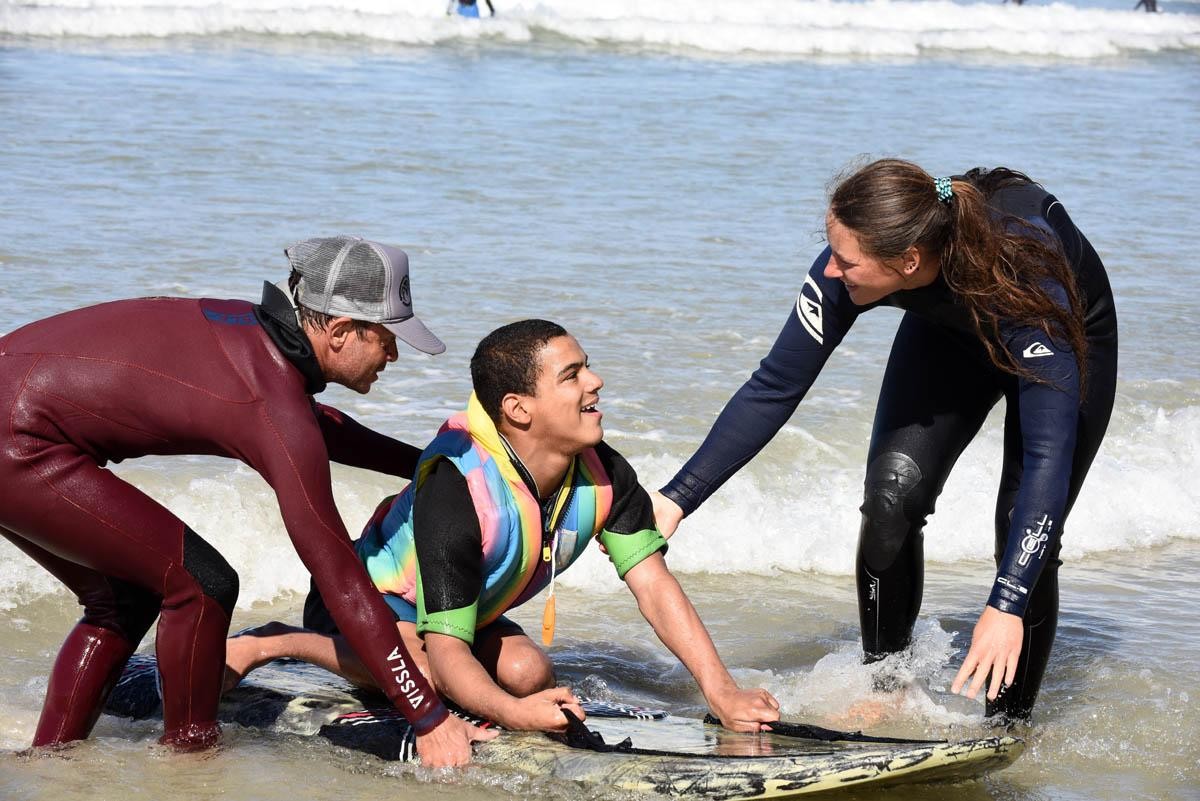
Communication and awareness between parties is essential for keeping an organisation afloat on a stormy sea. This assisted surfing outreach project called 'Smile and Wave' in Muizenberg, takes mentally and physically disabled children from the Cape Flats into the ocean. It takes clear and focused guidance and teamwork and the outcome is priceless. Photo by: Justin Sholk
Clearly communicating with your funder is essential. If, for example, you have stated what you intend to do in your proposal, and circumstances change due to external factors impacting on your project outcomes, then updating the funder timeously is essential to building trust and lasting relationships. This is where donor engagement strategies and clear communication skills are key to maintaining funding flow. This includes monitoring and evaluation on a regular basis.
Tulp advises organisations seeking funding to be very principled and discerning in how they budget when applying for funds. This means finding a balance between focusing on achieving impactful goals and actions and avoiding inflated budgets, keeping remuneration reasonable and managing funds.
“Obviously, as a funder, one wants to help as many projects to make an impact on the ground as possible. In order to do that, you have to make sure the budget is realistic, so that other people and organisations also have a chance to make an impact”, explains Tulp, who has worked as a professional NGO consultant in the Western Cape South Africa, and over the years, has built strong relationships of trust with philanthropic grantmaking organisations.
“So, it’s about accountability, or what I call ethical fundraising, really, although that sounds a bit heavy, but it’s crucial that the money is channeled to the organisations that need it most on the ground, so those three pillars are very important.
This is why we need strong democratic institutions and active citizens to stand up, to speak out against abuse of power. It doesn’t matter which sector you work in, whether it be education, mental health or environmental conservation – the principle is the same. Whether defending against the extraction of natural resources, from metals and minerals, fossil fuel and forests to fish fauna and freshwater- there’s much to protect. Across the world, but especially here in South Africa, we have a lot to defend, and it seems we are currently facing a battle to protect what is left of these precious life-giving resources. It is particularly tough because the threat comes from big industry and international governments. So many NGOs are dealing with dynamics of Biblical proportions: David and Goliath comes to mind. They need to be as well-resourced as possible to be able to hold leaders accountable, keep power in check, and protect the environment. This is essential for the peaceful survival of future generations. As Gandhi famously once said, “There is enough in this world for everyman’s need, but not for everyman’s greed.”
This is why accountability alone isn’t enough. Smaller, grassroots organisations need to be empowered – and funders need to be educated. This is why understanding and maintaining donor engagement strategies are so important in order to build Capacity in NGOs in South Africa.
“Most funders prefer to give grants to big organisations that are equipped and used to managing sizable grants", explains Tulp. "This is sad because ideally, it should also be given to the smaller remote organisations. Locally led organisations are deeply rooted in their communities and are best placed to understand local challenges, offering context-specific interventions. This gives them an advantage over many large organisations that operate in multiple locations and often replicate certain interventions. Funders don’t easily fund smaller organisations in remote locations because they cannot always be certain that the money is being properly allocated. They want transparency and the assurance that it is managed in a way that is professional.”
Tulp Fundraising Services guide organisations in how to engage in NGO capacity building through efficient grant management and impact reporting. And by doing this right, winning trust and building confidence with funders, thereby securing future income and a good reputation.
Over the years, working in both the conservation and social NPO sectors, Hedwich Tulp has developed a keen ear for quickly assessing how an organisation works, which is why she is clear on the fundamentals of what is needed to support NGO capacity building as an active monitoring and evaluation consultancy in the Western Cape, working with NGOs in South Africa.
“You quickly get an idea of how things are being governed by how people speak: are they progressive, or not so progressive? Do they just follow the government agenda, or do they have their own agenda? Can they cleverly navigate the funding environment and are they able to sustain themselves? Are they innovative? Are they looking at the relevance and effectiveness of their actions regularly? Or are they just cemented in their belief systems of days gone by and are just repeating the same actions over and over again because they are used to them and nobody challenges them?
Tulp has got to know how funders work and think too (in terms of being a principled match-maker for clients as well as donors and philanthropists), so if you are looking for the best fundraising consultants in the Western Cape to meet your needs or at least a good affordable fundraising consultant in South Africa, you know where to look.